Pictorial
Guan-Guan: A Visual Cartography of Sound and Structure in the Shijing (Book of Songs)
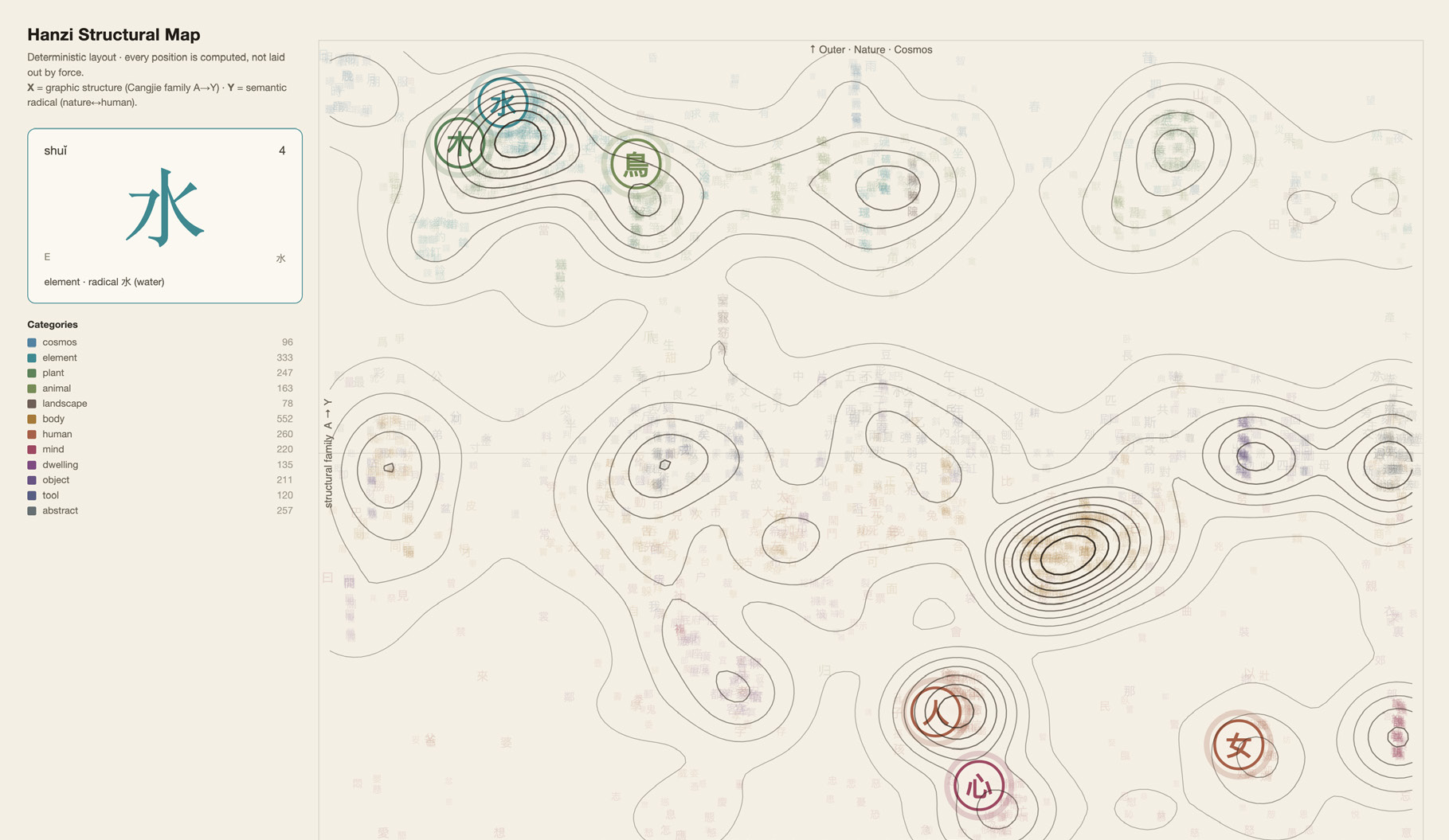
A map does what a diagram cannot: it stays. Its space can be revisited, learned, and compared; knowledge accumulates as familiarity with place. We bring this power to written language. Organized by graphic structure and semantic affiliation, our map functions as a stable landscape of Chinese characters, where every character holds one position in every text. On this ground, cartographic reading follows: poems turn into journeys, and the sound and language patterns of the Shijing (Book of Songs)—refrain, reduplication, tonal melody—become visible patterns of path and place. Guan-Guan demonstrates the mode: the anthology’s opening poem, ten movements.